 Cosmetic, Implant and General Dentistry
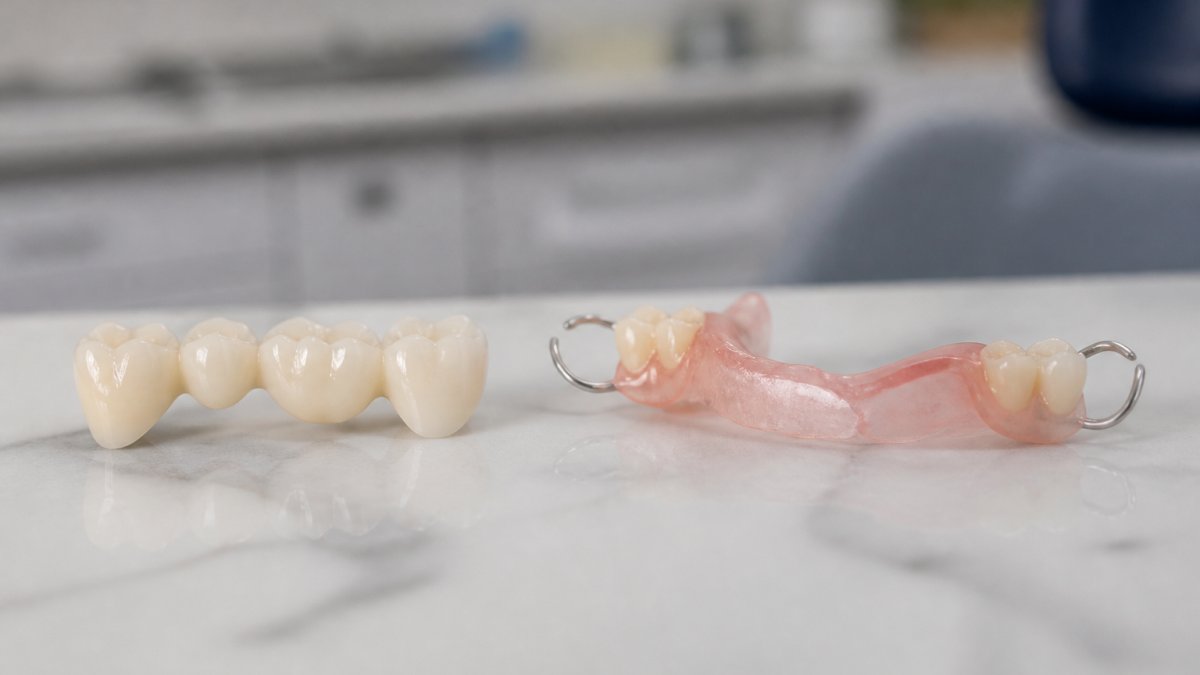
Table of Contents
- Dental Bridge vs Partial Denture for One Missing Tooth: The Core Decision
- How a Dental Bridge Replaces a Single Missing Tooth
- How a Partial Denture Replaces a Single Missing Tooth
- Side-by-Side Comparison: Fit, Comfort and Appearance
- The Cost of a Dental Bridge and the Cost of a Partial Denture
- How Long Does a Dental Bridge Last Compared With a Partial Denture?
- Caring for Your Replacement and Protecting Adjacent Teeth
- Which Option Is Right for You?
- Frequently Asked Questions
Last Updated: October 21, 2026
Dental Bridge vs Partial Denture for One Missing Tooth: The Core Decision
A [dental bridge](/dental-bridges/) versus partial denture for one missing tooth is the choice between a fixed replacement bonded to your neighbouring teeth and a removable one you take out at night.
Here is the part most guides get wrong: they compare bridges and dentures as if both were equally suited to a single gap. They are not. For one missing tooth, a bridge is usually the more comfortable long-term fix, while a partial denture is often the faster, cheaper route.
How a Dental Bridge Replaces a Single Missing Tooth
A dental bridge is a fixed restoration that fills a gap by anchoring a false tooth to the natural teeth on either side. Those neighbouring teeth, called abutment teeth, are trimmed down and fitted with crowns. The false tooth in the middle is the pontic, and it is held in place by those crowns.
For a single missing tooth, this means preparing two healthy teeth to carry one replacement. That is the trade-off nobody enjoys hearing. You gain stability and a natural feel, but you lose some tooth structure on both sides. A bridge relies on those adjacent teeth for bone support and bite force, so their health matters enormously.
How a Partial Denture Replaces a Single Missing Tooth
A partial denture is a removable appliance that replaces one or more missing teeth, usually with a metal framework, acrylic base and a gum-coloured section holding the false tooth. For a single gap, it clips onto your natural teeth and rests on the gum. You take it out to clean it and normally at night.
The appeal is simple: little or no drilling of healthy teeth. That makes a partial denture a sensible choice when the adjacent teeth are sound and you would rather not touch them. The catch is retention. A single-tooth partial can feel less secure than a bridge, and some patients notice movement when chewing.
Side-by-Side Comparison: Fit, Comfort and Appearance
Neither option is “better” in the abstract. They differ in how they feel, how they look and how much daily effort they demand. Here is how they stack up for one missing tooth.
| Factor | Dental Bridge | Partial Denture |
|---|---|---|
| Fixed or removable | Fixed, cemented in | Removable |
| Effect on adjacent teeth | Requires crowning them | Little or no drilling |
| Stability when chewing | High | Moderate |
| Appearance | Natural-looking porcelain | Good with custom fit |
| Cleaning routine | Normal brushing plus flossing under pontic | Remove and clean daily |
On appearance, a porcelain bridge blends closely with natural teeth. A well-made partial denture also looks convincing, but the metal clips can sometimes show. On comfort, most patients find a fixed bridge easier to forget about. A partial denture often needs a short adjustment period before it stops feeling foreign.
Ask your dentist to show you the pontic design before the bridge is made. A well-shaped pontic lets you clean underneath it, which protects the gum and the bone beneath the gap.
The Cost of a Dental Bridge and the Cost of a Partial Denture
A dental bridge almost always costs more up front than a single-tooth partial denture, because a bridge involves preparing and crowning two adjacent teeth plus the pontic itself, while a partial denture needs a frame, a base and a false tooth with little or no work on your natural teeth.
The spread is wide because the bridge fee is really three procedures bundled together: crown preparation on each abutment tooth, the laboratory-made crowns and pontic, and the fitting appointments. A partial denture fee is mostly laboratory work plus fitting and adjustment visits.
What drives the price up or down
- Number of units. A bridge replacing one tooth is a three-unit bridge (two crowns plus the pontic). More units, more cost.
- Material. All-ceramic or zirconia bridges cost more than metal-ceramic. A flexible partial with no metal framework can cost less than a cast metal partial, but may need replacing sooner.
- Condition of the abutment teeth. Heavily filled or previously crowned teeth may need core build-ups or root canal treatment first, which adds to the bridge fee.
- Laboratory and practice overheads. Fees vary widely between practices and regions, so compare written treatment plans rather than headline prices.
- Sedation, extra x-rays or specialist referral. These are add-ons that appear on some plans and not others.
Total cost of ownership, not just the first bill
The headline fee is only part of the story. Over the life of the restoration you should budget for:
- Bridge: replacement crowns if an abutment tooth fails, possible root canal treatment on a supporting tooth, and replacement of the whole bridge after years of wear. Interdental brushes and superfloss are cheap but essential.
- Partial denture: relines or adjustments as your gums and bone change shape, repairs if a clasp or the base cracks, replacement of the denture every few years, and denture cleaning products.
A useful way to compare is to ask each practice for a written treatment plan that lists every stage and every fee, then ask what the likely maintenance costs are over five and ten years. A cheaper partial denture that needs relining every couple of years can close the gap with a bridge, and a bridge that fails at an abutment tooth can cost more to rescue than a denture would have cost to replace. Costs vary by location and by case, so the only figure that matters is the one on your own written plan.
Ask for the treatment plan in writing and check whether it includes review appointments, adjustments and any laboratory remake policy. Those details separate a genuine quote from a headline number.
How Long Does a Dental Bridge Last Compared With a Partial Denture?
Those are qualified ranges, not guarantees, and anyone quoting a single fixed lifespan for either option is overselling. The variables that actually drive longevity are the same for both: the health of the supporting teeth and gums, your oral hygiene, your habits, and how faithfully you attend review appointments.
What shortens a bridge’s life
A bridge fails for one of three reasons. First, decay or gum disease around an abutment tooth: the crowned tooth is still a natural tooth underneath, and if plaque collects at the margin it can decay. Second, failure of the abutment tooth itself, such as a root fracture or loss of bone support, which can take the whole three-unit bridge with it. Third, wear or fracture of the pontic or the porcelain. Grinding and clenching, acidic drinks, and skipped interdental cleaning all accelerate these. A bridge cannot be repaired in the way a denture can; if an abutment fails, the restoration usually has to be cut off and remade.
What shortens a partial denture’s life
A partial denture does not fail because of decay under a crown, but because the mouth changes around it. Bone resorbs after tooth loss, gums recede, and clasps loosen. A denture that fitted well at fitting can become loose and start to rock within a couple of years, which is why relines and adjustments are a normal part of ownership rather than a sign of poor workmanship. Acrylic bases can crack, metal clasps can fatigue, and the false tooth can wear. Good daily cleaning, removing the denture at night, and storing it in water or a denture bath all extend its working life.
The factors that matter more than the material
- Oral hygiene. Interdental cleaning under the pontic for a bridge, and cleaning the denture and remaining teeth daily for a partial, are the single biggest levers.
- Habits. Smoking, grinding and a high-sugar diet shorten the life of both.
- Bone and gum health. A bridge depends on the bone around its abutment teeth; a denture depends on the shape of the ridge beneath it.
- Follow-up. Regular check-ups catch a failing margin or a loose clasp before it becomes an expensive problem.
- Material choice. All-ceramic and zirconia bridges resist wear well; flexible partials may need replacing sooner than cast metal frameworks.
A sensible way to think about it is that a bridge is a longer-lived but less repairable option, and a partial denture is a more repairable but shorter-lived one. Neither is permanent, and your maintenance habits and gum health drive the outcome far more than the material alone.
Ask your dentist what your own review schedule should be, because the answer depends on your gums, your habits and the teeth supporting the restoration.
Caring for Your Replacement and Protecting Adjacent Teeth
Good oral hygiene decides whether either restoration lasts. For a bridge, cleaning under the pontic is the part most people skip. Use interdental brushes or superfloss to reach beneath it, and brush the abutment crowns like normal teeth.
Watch the adjacent teeth closely in both cases. A common mistake is assuming a crowned tooth no longer needs attention. It does. Gum health and bone support around those teeth protect the whole restoration. Book regular check-ups so small problems are caught before they threaten the bridge or the denture.
Leaving a gap unfilled lets neighbouring teeth drift and tilt into the space. That can change your bite and make a future replacement harder, so delaying the decision has real consequences.
Which Option Is Right for You?
There is no single answer, and that is the point. A bridge suits you if the teeth either side of the gap are healthy enough to support crowns and you want a fixed, stable replacement you do not remove. A partial denture suits you if you would rather preserve those natural teeth and prefer a removable, often lower-cost route.
A few honest caveats. A bridge commits you to crown work on two teeth, and that is not reversible. A partial denture demands daily cleaning and may need adjustment as your gums change. If you are unsure, ask about candidacy at a consultation, where digital x-rays can show how your adjacent teeth and bone are holding up.
Frequently Asked Questions
What’s cheaper, a partial denture or a dental bridge?
A partial denture usually has a lower upfront cost than a dental bridge, because it needs no crowns on the neighbouring teeth and less laboratory work. A bridge often costs more initially but may need fewer repairs and replacements over the years. When comparing the cost of a dental bridge with the cost of a partial denture, ask your dentist for a full breakdown including fitting, adjustments and likely future maintenance, then judge the total outlay rather than the first invoice alone.
Can a partial denture replace just one missing tooth?
Yes. A single-tooth removable partial denture can fill one gap, often using small clasps or a flexible base that grips the adjacent teeth. It is a reversible option that leaves natural teeth largely untouched, which suits some patients who want to avoid drilling healthy teeth for a bridge. The trade-off is that a one-tooth denture can feel less stable than a fixed bridge, and it needs removing and cleaning daily.
Does a dental bridge damage the teeth next to the gap?
A conventional bridge requires shaping the adjacent teeth to carry crowns, which permanently removes some enamel. That is the main clinical downside. If those teeth are already heavily filled or crowned, the preparation changes little. If they are healthy and intact, some dentists prefer a resin-bonded bridge, which needs minimal or no drilling. Discuss with your dentist how much tooth preparation your specific case requires before deciding.
Which is easier to clean, a bridge or a partial denture?
A partial denture comes out, so you can brush it thoroughly at the sink and clean underneath it. A fixed bridge stays in place, so you clean under the pontic with interdental brushes, floss threaders or a water flosser to keep the gum and abutment teeth healthy. Neither is difficult once you build the habit, but a bridge demands more precision daily, while a denture demands consistent removal and soaking.
A missing tooth is not a problem that waits quietly. Teeth shift, bites change, and the fix gets more complex the longer you leave it. If you are weighing a dental bridge against a partial denture, book a consultation with U Smile Dental. We offer digital x-rays for a clear view of your adjacent teeth, a comfortable surgery environment, and a team that speaks your language. Get started with U Smile Dental and choose your replacement with confidence.