 Cosmetic, Implant and General Dentistry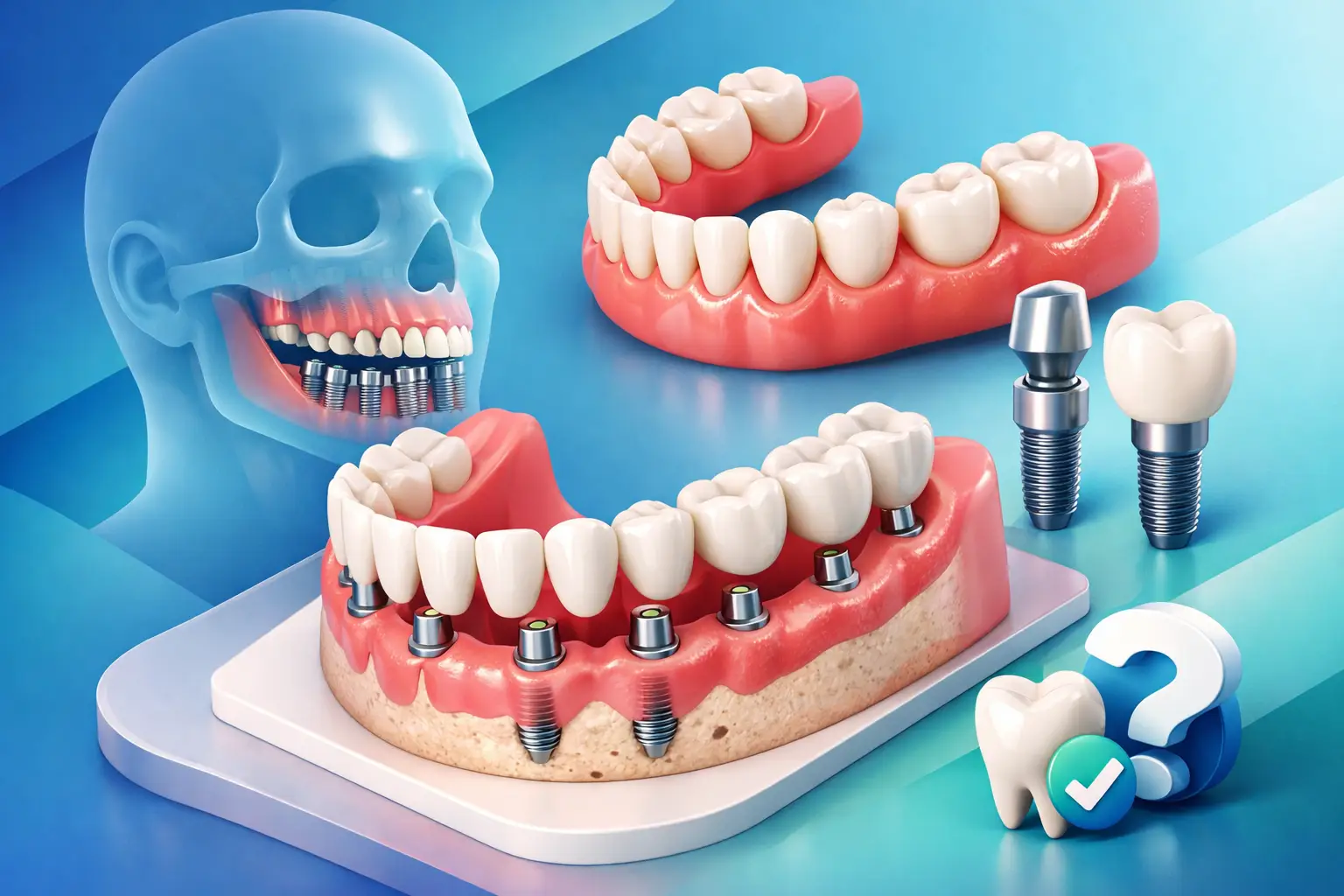
A loose denture can turn everyday moments into calculations: Can I eat this? Will it move when I speak? Will people notice? Full mouth dental implants are designed to replace that uncertainty with teeth that feel stable, look natural and are planned around your face, bite and lifestyle. For many people with missing or failing teeth, they offer a long-term alternative to removable dentures.
The right solution is not always the same for every patient. Your oral health, bone levels, medical history, expectations and budget all matter. A careful consultation should leave you clear about what is possible, what the process involves and what you will be investing in.
What are full mouth dental implants?
Full mouth dental implants replace all teeth in the upper jaw, lower jaw or both. Small titanium implant posts are placed into the jawbone, where they act like artificial tooth roots. Once they have integrated with the bone, they support a fixed bridge of new teeth.
Unlike a conventional denture, the replacement teeth are secured to implants rather than resting on the gums. This can improve stability when eating and speaking, while helping to maintain the shape of the jawbone that can gradually reduce after teeth are lost.
A full arch does not necessarily require one implant for every missing tooth. In many cases, a carefully designed bridge can be supported by a smaller number of strategically positioned implants. The number depends on the quality and quantity of bone, the bite, the arch being restored and the type of final bridge planned.
When might implants be the right choice?
This treatment is often considered by people whose teeth are already missing, severely worn, repeatedly breaking down or affected by advanced gum disease. It can also suit denture wearers who are tired of movement, sore pressure points and avoiding favourite foods.
The strongest candidates are not simply those with the most missing teeth. Successful implant treatment needs healthy or treatable gums, good oral hygiene habits and enough bone to support the implants. Smoking, uncontrolled diabetes, active gum disease and some medical treatments can affect healing, but they do not automatically rule treatment out. They do mean planning needs to be especially thorough.
If you still have some healthy natural teeth, keeping them may be the better choice. A good dentist will not recommend removing sound teeth purely to create a faster cosmetic result. The aim is to preserve what is healthy and restore what cannot be predictably saved.
What does the treatment journey involve?
Full mouth implant treatment begins with assessment, not a sales decision. Your dentist will examine your teeth and gums, discuss your health and take detailed imaging to assess the bone and important structures in the jaw. Photographs, scans and bite records help plan the appearance as well as the function of the new smile.
Planning the teeth before placing the implants
The final teeth should guide the implant plan. This matters because implants cannot be moved with braces once they are placed. The dentist considers tooth shape, smile line, lip support, facial proportions, speech and how your upper and lower teeth meet.
Where teeth need removing, they may be extracted at the implant appointment. Some patients may be suitable for provisional fixed teeth on the same day or shortly after surgery. Others need a healing period before their bridge is fitted. Same-day teeth can be an excellent option, but only where the implants achieve the stability needed and the bite can be controlled safely.
Healing and the final bridge
After implant placement, the jawbone needs time to fuse with the implant surface. This is called osseointegration and commonly takes several months, although every case follows its own timetable. During this time, temporary teeth may be used to protect the implants and maintain appearance.
Once healing is complete, impressions or digital scans are used to create the final bridge. High-quality materials can be chosen for strength and appearance, with the best option depending on the bite, the position of the teeth and how much natural-looking translucency is desired. The fitting stage includes careful checks for comfort, speech, bite balance and smile appearance.
The benefits people notice most
The most immediate benefit is often confidence. Fixed teeth do not need adhesive and should not lift when you laugh, talk or bite into food. Many patients also enjoy a wider food choice, although very hard foods should still be approached sensibly.
Appearance matters too. A well-planned bridge can restore the length, colour and shape of teeth that have become worn or uneven. It can also support lips and cheeks where tooth loss has caused a collapsed look. The most convincing result is not necessarily the brightest or largest smile. It is one that looks right for you.
There is a practical health benefit as well. Replacing missing tooth roots can help reduce ongoing bone loss in the jaw. Implants do not decay, but the gums and bone around them still need regular care. They are a long-term commitment, not fit-and-forget dentistry.
The trade-offs worth discussing honestly
Implant treatment involves surgery, healing time and a significant financial investment. Some patients need preparatory treatment, such as gum disease care, extractions or bone grafting, which can add time and cost. A bridge may also need repair, adjustment or replacement after years of use, particularly if you grind your teeth or place heavy pressure on it.
Cleaning is different from cleaning natural teeth. You will need to brush thoroughly around the bridge and use the recommended interdental brushes, floss aids or water-cleaning device beneath it. Regular professional reviews are essential to check the gums, bite and implant health.
There are risks with any surgical treatment, including swelling, bruising, discomfort, infection and implant failure. Upper-jaw and lower-jaw anatomy can create additional considerations. These risks are reduced through suitable planning and aftercare, but no responsible clinic should promise a guaranteed outcome.
Full mouth dental implants compared with dentures
A conventional full denture can be a sensible, lower-cost way to replace a full arch of teeth. It can also be made relatively quickly and adjusted as the mouth changes. However, dentures can move, reduce bite force and require relining or replacement over time as the gums and bone change shape.
Implant-retained dentures sit between a conventional denture and a fixed bridge. They clip securely onto implants but can be removed for cleaning. For some patients, this provides a valuable improvement in stability at a more manageable cost than a fully fixed solution.
Fixed full mouth dental implants are usually chosen by people who want the closest experience to having stable natural teeth again. The best choice depends on how you want the teeth to feel, your ability to maintain them, clinical suitability and what feels financially comfortable. There is no benefit in choosing a treatment that leaves you worried about the ongoing commitment.
How to judge quality and value
Comparing quotes alone can be misleading. Ask what is included: diagnostics and scans, extractions, temporary teeth, the number and type of implants, the final bridge material, reviews and any aftercare. You should also understand what happens if an implant does not heal as expected and whether future maintenance is included.
Look for a clinic that takes time to explain the plan in language you understand. At U Smile Dental, consultations are approached with clear discussion of the options, expected stages and costs, so patients can make an informed decision without feeling pressured. If English is not your preferred language, being able to discuss a major treatment clearly can make a real difference to confidence.
A lower price is only good value if planning, materials, clinical experience and follow-up care remain strong. Equally, a higher quote is not automatically better. The key is a transparent plan that explains exactly what you are receiving and why it suits your mouth.
Looking after your new smile
The habits that protect implants are straightforward but non-negotiable: clean carefully every day, attend hygiene and review appointments, avoid smoking where possible and wear a protective night guard if you grind your teeth. Let your dentist know promptly if you notice bleeding, a change in bite, looseness, discomfort or a chipped tooth.
Full mouth implant treatment can be life-changing, but the best starting point is not a decision made from a photograph or a price alone. It is a detailed consultation where you can ask questions, understand the alternatives and choose a smile that is built to serve you well for years to come.