 Cosmetic, Implant and General Dentistry
A missing tooth can affect far more than the gap you see in the mirror. You may start chewing on one side, avoid certain foods, feel less confident when smiling or notice nearby teeth moving over time. The right missing tooth replacement options can restore appearance and everyday comfort, but the best choice depends on where the tooth was, the health of your gums and bone, your priorities and your budget.
There is no one-size-fits-all answer. A single visible front tooth may call for a very different approach from several missing back teeth. A careful consultation should look at the whole picture, not simply fill the space as quickly as possible.
Why replacing a missing tooth is worth considering
Teeth work as a team. When one is missing, the teeth beside the gap can gradually lean inwards, while the tooth above or below may over-erupt because it no longer meets an opposing tooth. This can change your bite and make cleaning more difficult.
Missing back teeth can reduce chewing efficiency, particularly with firmer foods. Missing front teeth can affect speech as well as confidence. There can also be bone loss in the jaw where a tooth root is no longer present, which may influence future treatment choices.
Some people live comfortably with a gap, especially at the very back of the mouth. That can be reasonable in selected cases, but it is still worth having the area assessed. The decision should be informed, rather than something you feel forced into because treatment was never properly explained.
Missing tooth replacement options at a glance
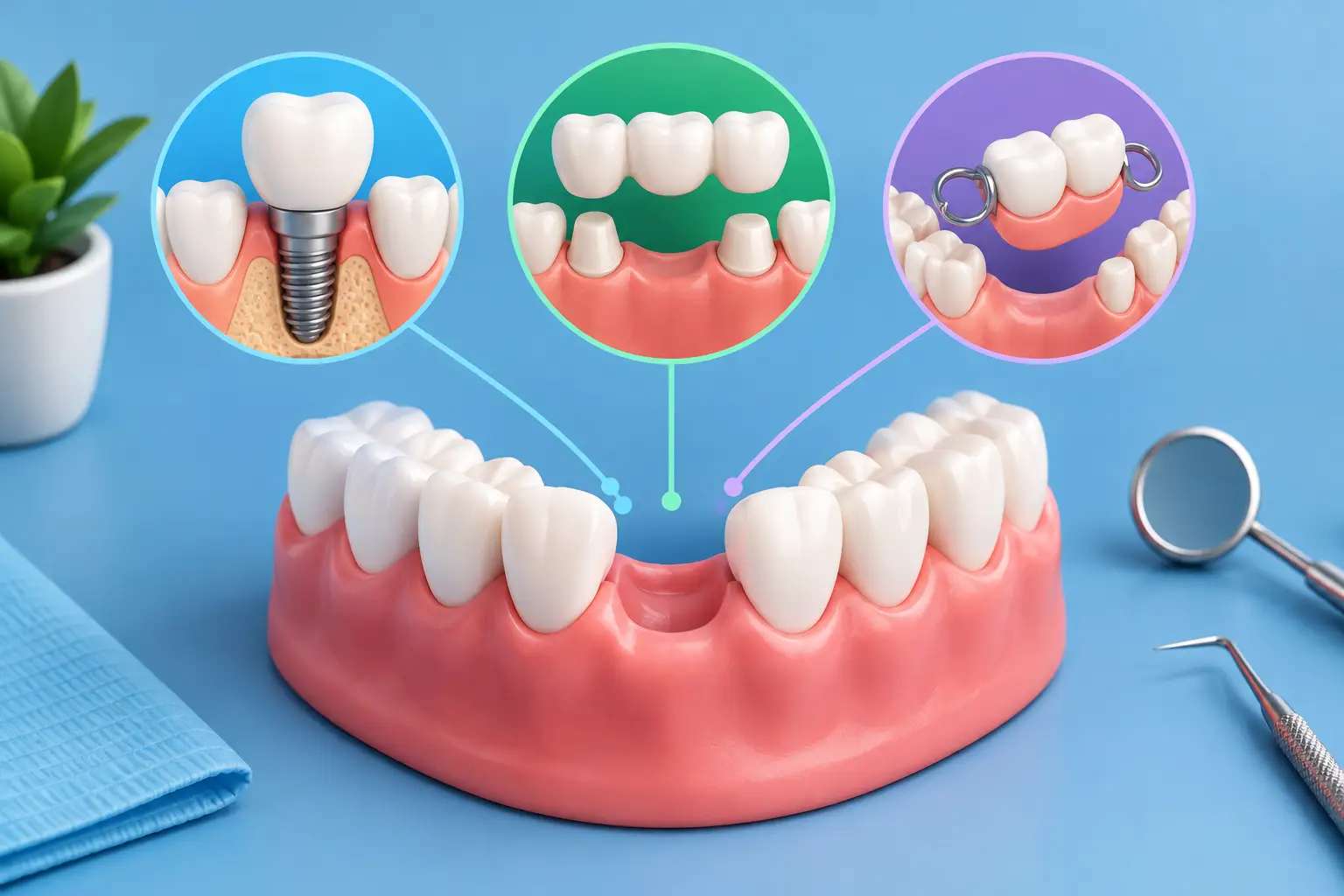
The main treatments are a dental implant, a fixed bridge, a removable denture or, in some circumstances, leaving the space under review. Each has genuine advantages and limitations.
Dental implants
A dental implant replaces the root of a missing tooth with a small titanium fixture placed into the jawbone. Once it has integrated with the bone, a carefully made crown can be attached on top. For several missing teeth, implants may support a bridge, and for a full arch they can offer much greater security than a conventional removable denture.
An implant is often the closest option to a natural tooth because it stands independently. It does not normally require neighbouring healthy teeth to be filed down, it feels fixed, and it can help maintain bone in the treated area. With good home care and regular professional maintenance, implant treatment can be a long-term solution.
The trade-off is that implant treatment takes planning and time. You need healthy enough gums and sufficient bone, although bone grafting may be possible where bone has been lost. Placement is a minor surgical procedure, and healing can take several months before the final crown is fitted. It is usually the higher initial investment, but its longevity and function can make it excellent value for the right patient.
Dental bridges
A bridge replaces a missing tooth by attaching a replacement tooth to the teeth on either side of the gap. A conventional bridge is often supported by crowns on adjacent teeth. A resin-bonded bridge, sometimes called a Maryland bridge, uses a discreet wing bonded to the back of a neighbouring tooth and can be particularly useful for a front tooth.
Bridges are fixed in place, so you do not remove them to clean. They can provide a very natural-looking result and are often completed more quickly than implants. A conventional bridge may be a sensible solution if the teeth beside the gap already have large fillings or need crowns anyway.
However, conventional bridges usually involve reshaping supporting teeth. They also need particular care when cleaning underneath the false tooth, using tools such as interdental brushes or floss threaders. A bonded bridge is more conservative, but it may not be suitable for every bite and can occasionally become loose. Your dentist will assess the position of the gap, the condition of nearby teeth and the forces placed on the restoration.
Removable dentures
A partial denture replaces one or more missing teeth and can be made from acrylic, metal or flexible materials. A full denture replaces all teeth in either the upper or lower jaw. Modern dentures can look attractive and improve speech, facial support and the ability to eat compared with having no teeth at all.
Dentures are usually the most accessible route when several teeth are missing, and they avoid surgery. They can also be a practical temporary solution while you are healing after extractions or considering a longer-term plan. For some patients, a well-made denture is exactly the right answer.
The adjustment period matters. A removable denture may feel bulky at first, and lower dentures can be less stable because there is less surface area to hold them in place. They must be removed for cleaning, and they may need relining or replacement as gums and bone change. Implant-retained dentures can offer a middle ground, using implants to hold a removable denture much more securely.
Leaving the space
Not every space needs immediate replacement. If a wisdom tooth has been removed, or if a back tooth has no opposing tooth and the bite remains stable, monitoring may be appropriate. This is not a shortcut decision. Your dentist should explain the possible effects on your bite, neighbouring teeth and future options, then review the area over time.
How to choose the right treatment
Start with function. Do you struggle to chew? Is the gap affecting your speech or changing how you bite? Then think about appearance, especially if the missing tooth is visible when you smile. These concerns are equally valid, and the aim is a result that looks right and works well.
Your oral health is the next consideration. Active gum disease, untreated decay or infection should be managed before restorative treatment begins. Implants, bridges and dentures all rely on a healthy mouth and a good cleaning routine. Smoking, teeth grinding and certain medical conditions may also affect the recommended plan, particularly for implant treatment.
Budget should be discussed openly. The cheapest option at the outset is not always the least expensive over many years if it needs frequent repair or replacement. Equally, the most comprehensive treatment may not be necessary for your circumstances. Ask for a written treatment plan that explains what is included, expected maintenance and any alternatives worth considering.
Timing can make a difference too. After a tooth is removed, the socket and surrounding bone begin to heal and change. In some cases, an implant can be planned soon after extraction; in others, healing first is safer. If a visible front tooth is being removed, a temporary replacement can often be arranged so that you are not left with an unwanted gap during treatment.
What a proper assessment should include
A good replacement plan begins with listening. Your dentist should ask what you want to improve, whether you have had dentures or bridges before and what has or has not worked for you. Examination of your teeth, gums, bite and jaw is followed by suitable X-rays, and implant planning may require detailed three-dimensional imaging.
Colour, shape and proportion matter just as much for a visible tooth. A replacement should complement your natural smile rather than look noticeably different. If several teeth are worn, discoloured or uneven, replacing a missing tooth can sometimes be part of a wider restorative or cosmetic plan, but only where that suits your goals.
At U Smile Dental, patients can discuss replacement choices in a calm, clear consultation, including the likely stages, costs and maintenance involved. For patients who are nervous, taking treatment at a comfortable pace and knowing what will happen next can make a substantial difference.
Looking after your new tooth
A crown on an implant cannot decay, but the gums and bone around it still need careful cleaning. Bridges require attention beneath the replacement tooth, while dentures should be cleaned daily and left out overnight unless your dentist advises otherwise. Regular check-ups allow small concerns, such as a loose bridge, sore denture area or gum inflammation, to be dealt with early.
If you have lost a tooth recently, do not assume you need to settle for a compromise that does not feel right. A clear assessment can show whether a bridge, denture or implant is appropriate for your mouth, your lifestyle and the smile you want to enjoy.