 Cosmetic, Implant and General Dentistry
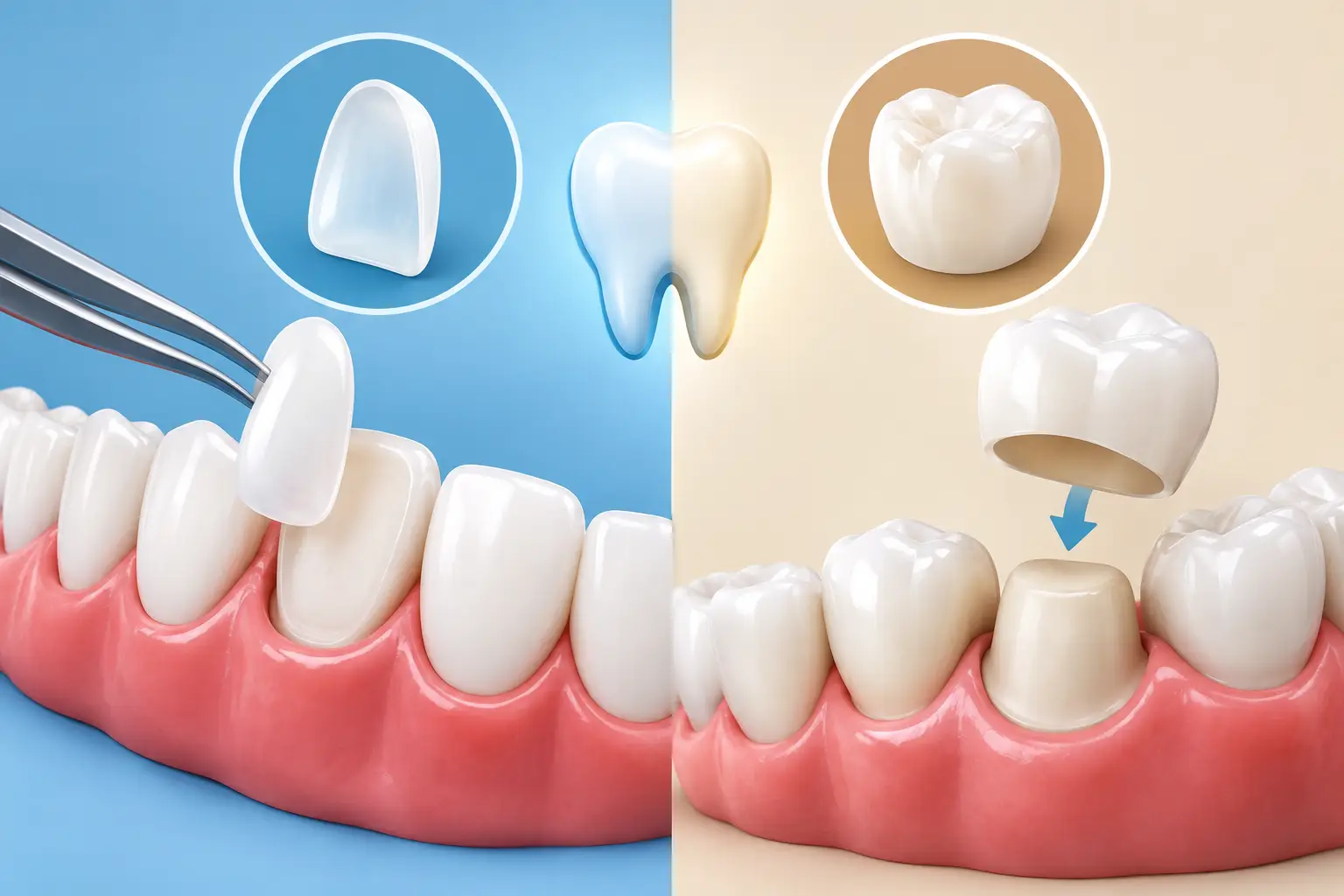
A chipped front tooth can make you hide your smile in photographs. A heavily filled back tooth may make chewing feel uncertain. Both situations can lead to the same question – veneers versus crowns: which treatment will look natural, last well and protect your tooth?
The answer depends less on which option is “better” and more on how much healthy tooth structure remains, where the tooth sits in your mouth and what you need it to do. A veneer is designed mainly to improve the visible front surface of a tooth. A crown covers the whole tooth, offering greater protection when it has been weakened by decay, a large filling, fracture or root canal treatment.
Veneers versus crowns: the key difference
Porcelain veneers are thin, custom-made shells bonded to the front of teeth. They are commonly chosen to improve the colour, shape, size or alignment of teeth that show when you smile. A veneer can close small gaps, disguise chips and create a more even, brighter smile without covering every part of the tooth.
A dental crown, sometimes called a cap, fits over the entire visible portion of a tooth. It restores strength as well as appearance. Modern porcelain crowns can be carefully colour-matched and shaped to blend beautifully with neighbouring teeth, so choosing a crown does not mean compromising on a natural-looking result.
Think of it this way: a veneer is often an aesthetic enhancement for a tooth that is fundamentally healthy and strong. A crown is usually a restorative solution for a tooth that needs more support, although it can also improve its appearance.
When a veneer may be the right choice
Veneers are particularly effective for front teeth with cosmetic concerns. If your teeth are sound but you dislike persistent staining, uneven edges, minor wear, small gaps or slightly irregular shapes, veneers may offer a refined and long-lasting improvement.
Porcelain is popular because it reflects light in a similar way to natural enamel and resists staining better than composite bonding. This makes it a strong option for patients seeking a brighter, more uniform Hollywood Smile. Your dentist can tailor the shade, translucency and proportions so the result suits your face rather than looking overly white or artificial.
Preparing a tooth for a veneer usually involves removing a small amount of enamel from its front surface. In some carefully selected cases, very minimal-preparation veneers may be possible. However, no-preparation treatment is not suitable for every smile. If teeth already protrude or are crowded, placing porcelain over them without making space can create a bulky result.
A veneer is not normally the best choice if a tooth has extensive decay, a very large old filling, deep cracks or has lost significant structure. Bonding a beautiful veneer to an unstable foundation is unlikely to provide the reliable outcome you want.
What veneers can and cannot correct
Veneers can create a dramatic change where the main concern is the look of visible teeth. They can improve mild spacing and minor crookedness, but they do not move teeth or correct a bite. Where teeth are significantly crowded, Invisalign treatment may be a better starting point, sometimes followed by whitening, bonding or veneers for final detail.
They also cannot treat untreated gum disease, active decay or infection. Healthy gums are essential to a tidy, long-lasting veneer margin. If your gums bleed when brushing, appear swollen or have receded, this should be assessed before any cosmetic work is planned.
When a crown is the safer option
Crowns are recommended when a tooth needs to cope with everyday biting forces but no longer has enough healthy structure to do so confidently. This may be after a large filling has weakened the tooth, after root canal treatment, or when a cusp has fractured. Back teeth often need crowns because they take most of the pressure when chewing.
The tooth is shaped to create room for the crown, then a custom restoration is made to fit over it. Depending on the tooth and its position, your dentist may recommend all-ceramic porcelain, zirconia or another high-quality material. The goal is a precise fit, comfortable bite and appearance that works naturally with the rest of your smile.
For a front tooth, a porcelain crown can be an excellent choice if the damage is too extensive for a veneer. It covers the darker colour that can sometimes follow trauma or root canal treatment and rebuilds the tooth’s shape from all sides. A skilled shade match matters here, particularly where only one front tooth is being restored.
Crowns do involve more tooth preparation than veneers because they require space all around the tooth. That is why a crown should not be used simply because it seems like the more comprehensive cosmetic treatment. Preserving healthy enamel where possible remains a sensible priority.
Appearance, durability and maintenance
Both high-quality veneers and crowns can look very natural and can last many years with good care. Their lifespan is affected by your bite, oral hygiene, diet, habits and how much pressure the restoration receives. There is no fixed expiry date, but regular examinations allow small problems to be identified before they become more costly.
Porcelain does not decay, but the natural tooth and gum around it still can. Brushing twice daily with fluoride toothpaste, cleaning between teeth and attending hygiene appointments are essential. Avoid using teeth to open packaging, bite fingernails or hold objects. These habits can chip porcelain or loosen the bond.
If you clench or grind your teeth, tell your dentist before treatment begins. Night-time grinding places considerable force on veneers and crowns. A custom night guard may be advised to help protect your investment and reduce strain on your natural teeth and jaw.
Whitening also needs planning. Whitening changes the colour of natural teeth, not porcelain. If you are considering veneers or crowns as part of a brighter smile, it is usually best to whiten first and then select the final shade of the restoration. This helps ensure your new teeth continue to match after whitening is complete.
Cost should reflect the treatment you actually need
It can be tempting to compare veneer and crown prices as if they are interchangeable products. They are not. The right treatment plan is based on the condition of each tooth, the materials used, the time needed for planning and fitting, and whether additional care is required first.
A tooth may also need different treatment from the one beside it. For example, a patient could have veneers on healthy front teeth to improve their shape and colour, while a heavily restored tooth receives a crown for strength. A balanced smile is not always created by applying the same solution to every tooth.
During a consultation, ask what is being preserved, what preparation is required and what would happen if you chose the less extensive option. You should also ask how your bite, gum health and existing fillings affect the recommendation. Clear answers help you compare value properly, rather than focusing only on the initial fee.
Choosing with confidence
The best decision is made after a close examination, photographs and a discussion about what you want to change. Bring examples of smiles you like, but be open about practical priorities too: perhaps you want a brighter smile for a wedding, need to repair a tooth before it breaks further, or want treatment that feels manageable around work and family commitments.
At U Smile Dental, a consultation can help turn that uncertainty into a clear plan, whether your smile needs subtle cosmetic refinement, stronger restoration or a combination of both. The most worthwhile result is not the one with the most porcelain – it is the one that protects your teeth and lets you smile, speak and eat without holding back.